Three geographically distinct parent populations — North American/South American foundation, Australian imported semen, and Eastern European lines — triangulated to produce offspring with maximized heterozygosity and hybrid vigor.
Geographic and genetic triangulation is the intentional strategy of combining three geographically distinct, unrelated parent populations within the same breed to maximize genetic diversity in offspring. Rather than a simple two-way pairing, triangulation draws from separate gene pools rooted in different parts of the world — in our program, North American/South American, Australian, and Eastern European lines — to produce offspring with the broadest possible allelic range.
The scientific term for the resulting benefit is heterosis, also called hybrid vigor: the measurable improvement in vitality, robustness, and overall health that results when genetically distant individuals of the same breed are mated. Heterotic offspring often exhibit traits that exceed the simple sum of both parents — greater immune function, structural soundness, and life vitality.
Triangulation within a purebred breed is distinct from crossbreeding. The goal is not to blend breeds — it is to access the full genetic depth that exists within a single breed's worldwide population, which has been divided by geography, registry, and decades of separate breeding decisions.
Geographic isolation between populations results in measurable subpopulation differentiation. Studies on breeds such as the Italian Greyhound and Shetland Sheepdog confirm that dogs from different continents cluster together genetically — and that US populations originating from only a handful of imported dogs show higher genetic distance and lower heterozygosity than their counterparts elsewhere in the world.
This is why importing from geographically distant countries is not just a pedigree preference — it is a scientifically measurable way to increase genetic variation. Geographic origin plays an important role in shaping genetic clusters, with breed populations from Australia, Eastern Europe, and North/South America each forming distinct genetic groupings that are meaningfully different from one another.
"The US populations of both breeds are strikingly different from their European counterparts, likely due to a founder effect — resulting in higher FST and lower heterozygosity values."
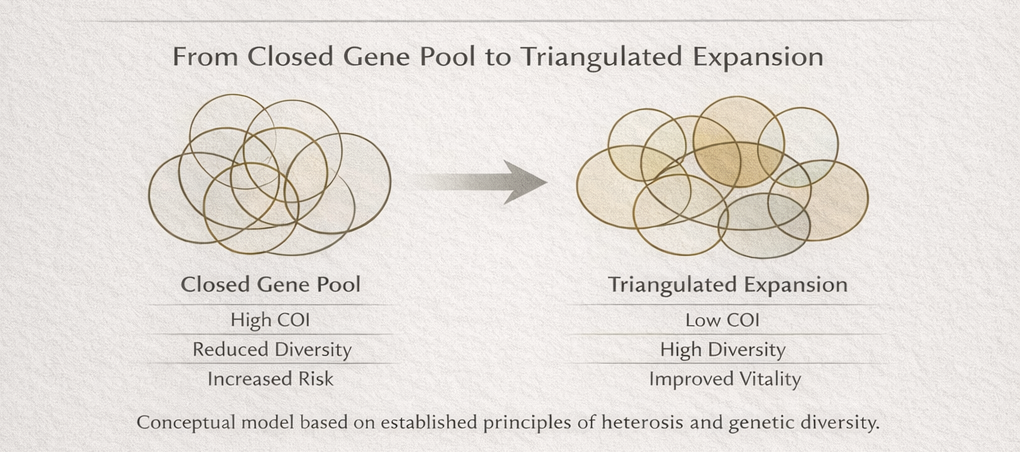
— Genomic study, Companion Animal Health and Genetics (2020)When a breed arrives in a new country through a small number of founding dogs, every generation that follows recombines a limited set of alleles. Over decades, even breeders who carefully avoid close relatives on paper are unknowingly mating dogs that share deep common ancestry. This is population-wide inbreeding, and it does not show up on a standard pedigree COI calculation.
Heterosis — hybrid vigor — is not a theory. It is a well-documented biological phenomenon observed across species wherever genetically distant individuals of the same kind are mated. Crossing parents from geographically diverse regions increases the likelihood of high genetic distance, which correlates positively with vigor, health, and fitness improvements in offspring.
One of the most important mechanisms involves the Major Histocompatibility Complex (MHC). Breeding between more genetically distant individuals decreases the chance of inheriting two identical or similar MHC alleles. A more diverse MHC allows a greater range of antigens to be recognized, meaning offspring mount a broader and stronger immune response — they are simply harder to get sick.
Beyond immune function, heterosis is associated with improved reproductive performance, litter vitality, structural soundness, and longevity. These are not marginal gains. In agricultural breeding programs where this is rigorously measured, heterosis consistently produces offspring that outperform both inbred parent lines.
Inbreeding depression is the measurable decline in health, vitality, and fitness that accumulates when a population recombines the same genetic material across generations. It is not a single event — it is a slow, generational narrowing that manifests as smaller litters, reduced immune competence, shorter lifespans, and higher rates of hereditary disease expression.
Selecting parents from distinct geographic backgrounds and breeding programs avoids the mating of close relatives that leads to homozygous deleterious recessive alleles. When both copies of a gene are identical, a single recessive mutation can express fully. When the copies differ, the healthy allele typically masks the recessive one.
Breeding for heterozygosity directly addresses each of these. A decrease in heterozygosity pairs with an increased number of disease variants being expressed in two copies — a pattern confirmed in analyses of over one million dog DNA samples across more than 150 countries.
Effective triangulation rests on four interconnected principles. Understanding all four is what separates a strategic breeding program from one that simply imports a dog.
Cross parents from geographically diverse regions to increase the likelihood of high genetic distance and all its downstream benefits — immune breadth, structural vigor, longevity.
Select parents from distinct geographic backgrounds and breeding programs to avoid mating close relatives and the accumulation of homozygous recessive alleles.
Instead of simple two-way pairings, draw from three distinct populations. Each additional unrelated contributor further reduces the probability of any recessive allele appearing in both copies.
Use genomic diversity testing — SNP profiles — to confirm that geographic distance equates to actual genetic distance. Pedigree alone is not sufficient verification.
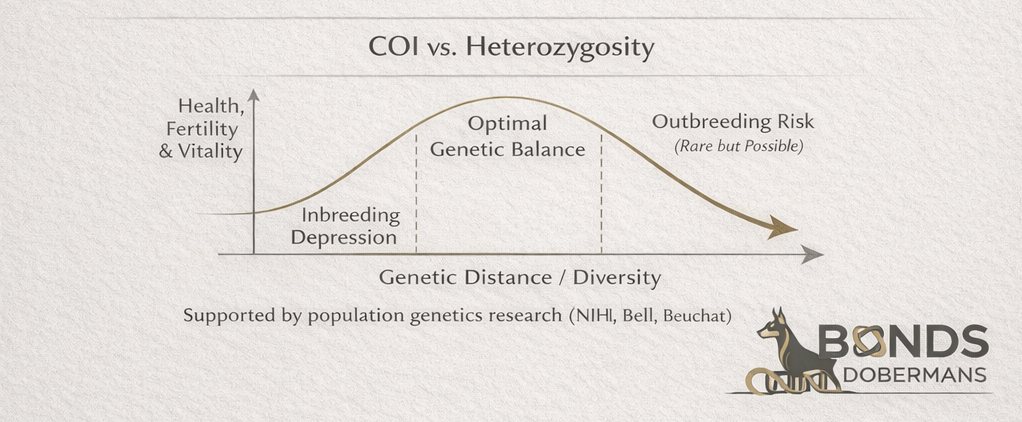
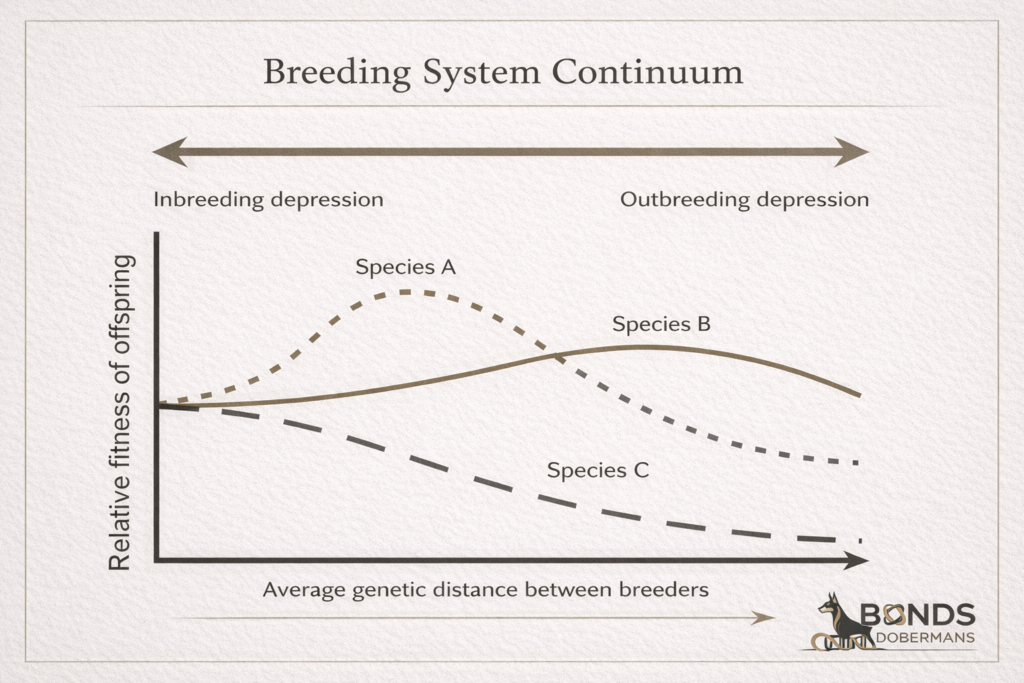
While genetic distance increases vigor, excessively high distance can cause outbreeding depression — where local adaptation is lost and gene products become incompatible, resulting in reduced fitness. This is the upper bound that triangulation must respect.
Within a single breed, outbreeding depression is far less of a concern than in wild species, because breed standards have already established a shared developmental blueprint. A Doberman from Australia and a Doberman from North America share the same foundational genetic architecture. The variation between them is meaningful — but it is variation within a compatible framework.
Not all geographic distance is equal. Australian lines share some British foundation genetics with North American lines, making them a moderate distance contributor — meaningful diversity without the risk of incompatibility. Eastern European lines represent the greatest genetic distance from the North American gene pool, delivering the highest heterosis potential. Together, the three populations in our triangulation span a calibrated range from moderate to maximum genetic distance.
Eastern European lines represent the greatest genetic distance from the North American gene pool in our triangulation framework. Countries such as Serbia, Czech Republic, Slovakia, Hungary, and surrounding regions have maintained breeding programs that developed largely independently of North American and Western European registries — producing dogs that carry alleles simply unavailable anywhere in the domestic population.
The Eastern European breeding culture has historically emphasized working performance, structural soundness, and health over show ring conformity. This selection pressure has, as a byproduct, kept gene pools broader and more functionally diverse than populations shaped primarily by conformation standards.
The greater the genetic distance between parent populations, the higher the probability of heterosis in the offspring. Eastern European lines, having developed in relative isolation from North American sire lines for generations, carry the highest proportion of alleles that are absent or rare in the domestic gene pool. When paired with a North American foundation female like Violet, those alleles have the greatest opportunity to produce the complementation effect that drives hybrid vigor.
Australian lines occupy a unique position in the triangulation framework — they represent moderate genetic distance from North American populations. Australia's geographic isolation means its Doberman gene pool has developed largely independently of North American sire dominance, but its British foundation genetics create a degree of compatibility that makes it an ideal middle point in the triangulation.
In our program, Australian genetics are introduced via imported semen — allowing access to high-quality, proven genetics from the Australian gene pool without the health documentation complexity of a live import. Semen importation is a well-established reproductive technology in purebred breeding and allows breeders to access global genetics with precision.
A common misconception is that maximum genetic distance is always the goal. In practice, a calibrated range of distances produces the most robust offspring. The Australian contribution provides meaningful heterozygosity gains over a simple domestic pairing, while the Eastern European contribution delivers the maximum distance point. Together they bracket Violet's North American/South American foundation from two distinct directions — creating true triangulation rather than a simple outcross.
The case for geographic triangulation is not abstract. It is visible in lifespan data spanning five decades. Multiple independent studies show a consistent downward trend in Doberman average lifespan — from approximately 12–13 years in the 1970s to 8–9 years today. The same data shows what is possible when the trend is reversed: Euro/American hybrid Dobermans live measurably longer than their closed-line counterparts.
Methodology note: These data points are drawn from independent studies using different methodologies and populations. They do not constitute a single longitudinal dataset. The trend they describe is corroborated across multiple independent lines of evidence.
Selective breeding for desirable traits in strictly controlled populations has generated extraordinary diversity in canine morphology and behavior — but has also led to loss of genetic variation and random entrapment of disease alleles. This is not a criticism of purebred breeding. It is the natural consequence of any closed population, and it is a problem that responsible breeders can actively address.
Breeding practices such as extreme selection for competition winners or restricted pedigrees are strong drivers of population fragmentation — measurably stronger in show dog lineages than in working lines, where complex functional traits demand broader genetic expression.
"Dogs from the breadth of the gene pool should be used for breeding as long as they represent health and quality."
— Dr. Jerold Bell, DVM — Adjunct Professor of Genetics, Tufts UniversityTriangulation is the antidote to this trajectory. By consistently reaching across geographic and pedigree lines — to Australia, to Eastern Europe, and anchoring in a strong North American/South American foundation — we actively counteract the natural narrowing that occurs in any closed population, not by abandoning breed standards, but by honoring the full global breadth of the breed.
When we select breeding partners, geographic and genetic triangulation is a deliberate part of our strategy — not an afterthought. Our current program triangulates three populations: Violet as our North American/South American foundation, Australian imported semen as a moderate-distance contributor, and Eastern European lines as the maximum-distance point. The result is offspring carrying the vitality, structural soundness, and health that come from a truly diverse genetic foundation.
Our breeding decisions are informed by:
The goal is not diversity for its own sake — it is health, vitality, and the kind of offspring that thrive into their 13th and 14th years. Triangulation is how we get there systematically rather than by chance.
Genetics advisor to national parent breed clubs and leading voice on canine hereditary disease. Dr. Bell emphasizes using dogs from the breadth of the gene pool and advises that the most common genetic diseases trace to ancient liability genes predating breed separation.
Vertebrate biologist and founder of the Institute of Canine Biology. Dr. Beuchat's work focuses on managing genetic health in purebred populations, conservation genetics, and breed population sustainability. Member of the IUCN Conservation Breeding Specialist Group.
instituteofcaninebiology.org ↗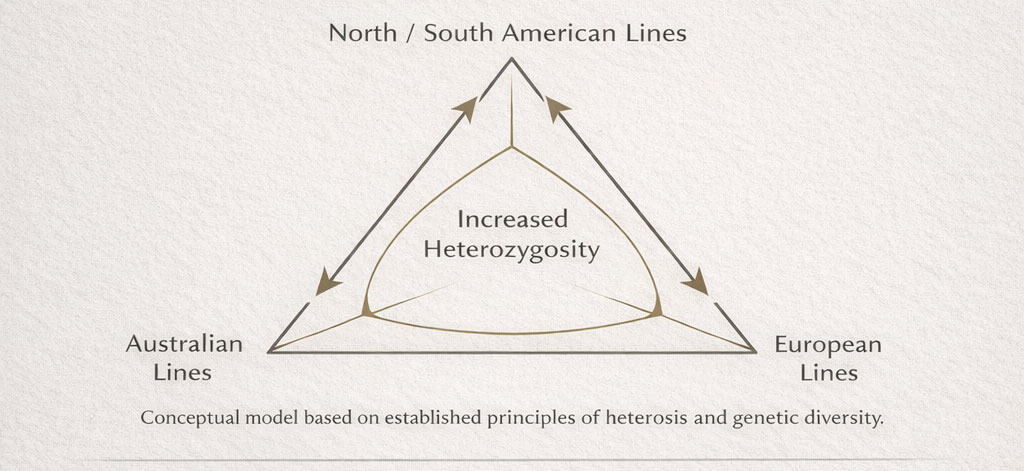
The principles of genetic diversity, heterozygosity, and hybrid vigor (heterosis) are well-established across population genetics, animal breeding, and agricultural science. The following research supports the concepts applied within the Bonds Triangulation Framework™.
Hybrid vigor (heterosis) & genetic distance
Hybrid vigor describes the improved performance of offspring compared to parent populations, often resulting in increased growth, fertility, and resilience. Studies consistently show that greater genetic distance between parent populations can increase heterosis, though optimal outcomes depend on maintaining balance and compatibility between lines.
Cross-breeding and enhanced fitness
Cross-breeding between genetically distinct populations has been shown to produce offspring with enhanced fitness, including improved disease resistance and overall vitality.
Geographic isolation & subpopulation differentiation
Geographic isolation between dog populations results in measurable subpopulation differentiation. US populations show higher genetic distance and measurably lower heterozygosity than their European counterparts — primarily due to founder effect.
Inbreeding depression & heterozygosity
Breeding for heterozygosity reduces the risk of inbreeding depression, where accumulation of deleterious mutations leads to lower individual fitness — including smaller litters, reduced lifespan, and increased mortality in offspring.
Heterosis vs. outbreeding depression
The net fitness consequences of between-population crosses are a balance between heterosis and outbreeding depression. Within a single breed, outbreeding depression is far less of a concern because breed standards establish a shared developmental blueprint.
Primary scientific literature and institutional resources supporting the Bonds Triangulation Framework™.
"Dogs from the breadth of the gene pool should be used for breeding as long as they represent health and quality. The most common genetic diseases seen by veterinarians are due to ancient liability genes that originated in ancestors that preceded the separation of breeds."
— Dr. Jerold Bell, DVM, Adjunct Professor of Genetics, Tufts UniversityDr. Jerold Bell, DVM — Genetic diversity management and breed-wide health strategy. Adjunct professor of genetics at the Cummings School of Veterinary Medicine at Tufts University and genetics advisor to national parent breed clubs.
Dr. Bell — Genetic Diversity Management (VIN) ↗
"The loss of genetic diversity can pose a threat to breed health. Breeding practices such as extreme selection for competition winners or restricted pedigrees accelerate population fragmentation and inbreeding."
— Dr. Carol Beuchat, PhD, Institute of Canine BiologyDr. Carol Beuchat, PhD — Preservation of genetic variation and population sustainability. Founder of the Institute of Canine Biology, member of the IUCN Conservation Breeding Specialist Group.
These principles consistently point to one conclusion: Genetic diversity is not maintained by staying within the same lines — but by intentionally expanding beyond them.
The Bonds Triangulation Framework™ applies this research through structured, multi-line breeding strategies designed to:
"Distance creates strength. Triangulation is not a trend — it is the science of building dogs that last."
— Bonds Dobermans
Written by
Doberman Breeder & Genetic Diversity Advocate · Guyton, Georgia
Bonnie Gringer is the founder of Bonds Dobermans, a purpose-bred program based on the coast of Georgia dedicated to health testing, genetic renewal, and extended longevity in the Doberman breed. With over 15 years of experience in purpose breeding across Friesian horses and Dobermans — including international bloodline import and pedigree research — Bonnie brings both scientific rigor and deep personal commitment to the future of the breed.